Focus on elections, political parties, parliaments and participation. Pay particular attention to who elects whom and to the different roles of the government, the opposition and members of parliament.
English translations help you learn. The official examination is in German.
Wahlen in Deutschland sind frei. Was bedeutet das?
Elections in Germany are free. What does that mean?
Man darf Geld annehmen, wenn man dafür eine bestimmte Kandidatin / einen bestimmten Kandidaten wählt.You may accept money if you vote for a particular candidate in return.
Nur Personen, die noch nie im Gefängnis waren, dürfen wählen.Only people who have never been in prison are allowed to vote.
Die Wählerin / der Wähler darf bei der Wahl weder beeinflusst noch zu einer bestimmten Stimmabgabe gezwungen werden und keine Nachteile durch die Wahl haben.Voters must neither be influenced nor forced to cast a particular vote, and they must not suffer any disadvantages because of their vote.
Alle wahlberechtigten Personen müssen wählen.All eligible voters are required to vote.
Correct answer and explanation
C.Die Wählerin / der Wähler darf bei der Wahl weder beeinflusst noch zu einer bestimmten Stimmabgabe gezwungen werden und keine Nachteile durch die Wahl haben.
Voters must neither be influenced nor forced to cast a particular vote, and they must not suffer any disadvantages because of their vote.
Free elections mean that no one may be forced to make a particular electoral choice. Voters should be able to decide for themselves without pressure and without disadvantages.
Question 13
Im Parlament steht der Begriff 'Opposition' für …
In parliament, the term 'opposition' refers to …
die regierenden Parteien.the governing parties.
die Fraktion mit den meisten Abgeordneten.the parliamentary group with the most members.
alle Parteien, die bei der letzten Wahl die 5%-Hürde erreichen konnten.all parties that were able to reach the 5% threshold in the last election.
alle Abgeordneten, die nicht zu der Regierungspartei / den Regierungsparteien gehören.all members of parliament who do not belong to the governing party or governing parties.
Correct answer and explanation
D.alle Abgeordneten, die nicht zu der Regierungspartei / den Regierungsparteien gehören.
all members of parliament who do not belong to the governing party or governing parties.
The opposition consists of the members of parliament and parties that do not support the government. They scrutinize the government and represent different political positions.
Question 20
Eine Partei in Deutschland verfolgt das Ziel, eine Diktatur zu errichten. Sie ist dann …
A political party in Germany aims to establish a dictatorship. It is therefore …
tolerant.tolerant.
rechtsstaatlich orientiert.oriented toward the rule of law.
gesetzestreu.law-abiding.
verfassungswidrig.unconstitutional.
Correct answer and explanation
D.verfassungswidrig.
unconstitutional.
A party that seeks to establish a dictatorship and abolish the democratic order acts against the constitution. Such an aim is therefore considered unconstitutional.
Question 28
Wer wählt in Deutschland die Abgeordneten zum Bundestag?
Who elects the members of the Bundestag in Germany?
das Militärthe military
die Wirtschaftthe business sector
das wahlberechtigte Volkthe electorate
die Verwaltungthe administration
Correct answer and explanation
C.das wahlberechtigte Volk
the electorate
The members of the German Bundestag are elected by eligible voters. Through elections, citizens decide who represents them in the Bundestag.
Question 30
Was ist kein Merkmal unserer Demokratie?
What is not a feature of our democracy?
regelmäßige Wahlenregular elections
Pressezensurpress censorship
Meinungsfreiheitfreedom of expression
verschiedene Parteiendifferent political parties
Correct answer and explanation
B.Pressezensur
press censorship
Press censorship is not a feature of a democracy. Freedom of expression, different political parties, and regular elections are, by contrast, features of a democracy.
Question 31
Die Zusammenarbeit von Parteien zur Bildung einer Regierung nennt man in Deutschland …
The cooperation of political parties to form a government is called a … in Germany.
Einheit.unity.
Koalition.coalition.
Ministerium.ministry.
Fraktion.parliamentary group.
Correct answer and explanation
B.Koalition.
coalition.
When several parties jointly form or support a government, this cooperation is called a coalition. The participating parties agree on common political goals.
Question 41
Warum gibt es in einer Demokratie mehr als eine Partei?
Why is there more than one political party in a democracy?
weil dadurch die unterschiedlichen Meinungen der Bürgerinnen und Bürger vertreten werdenbecause this allows the different opinions of citizens to be represented
damit Bestechung in der Politik begrenzt wirdto limit bribery in politics
um politische Demonstrationen zu verhindernto prevent political demonstrations
um wirtschaftlichen Wettbewerb anzuregento encourage economic competition
Correct answer and explanation
A.weil dadurch die unterschiedlichen Meinungen der Bürgerinnen und Bürger vertreten werden
because this allows the different opinions of citizens to be represented
In a democracy, there are different political parties so that different political opinions can be represented. Citizens can therefore choose between different political options.
Question 43
Wann kann in Deutschland eine Partei verboten werden?
When can a political party be banned in Germany?
wenn ihr Wahlkampf zu teuer istif its election campaign is too expensive
wenn sie gegen die Verfassung kämpftif it fights against the constitution
wenn sie Kritik am Staatsoberhaupt äußertif it criticizes the head of state
wenn ihr Programm eine neue Richtung vorschlägtif its program proposes a new direction
Correct answer and explanation
B.wenn sie gegen die Verfassung kämpft
if it fights against the constitution
A political party can be banned if it fights against the constitutional democratic order. Criticism of political figures or new political proposals alone are not grounds for banning a party.
Question 44
Wen kann man als Bürgerin / Bürger in Deutschland nicht direkt wählen?
As a citizen in Germany, whom can you not elect directly?
Abgeordnete des EU-Parlamentsmembers of the European Parliament
Die Bundespräsidentin / den Bundespräsidententhe Federal President
Landtagsabgeordnetemembers of a state parliament
Bundestagsabgeordnetemembers of the Bundestag
Correct answer and explanation
B.Die Bundespräsidentin / den Bundespräsidenten
the Federal President
The Federal President is not elected directly by the citizens. The election is carried out by the Federal Convention.
Question 57
Wer wird meistens zur Präsidentin / zum Präsidenten des Deutschen Bundestages gewählt?
Who is usually elected President of the German Bundestag?
die / der älteste Abgeordnete im Parlamentthe oldest member of parliament
die Ministerpräsidentin / der Ministerpräsident des größten Bundeslandesthe Minister-President of the largest federal state
eine ehemalige Bundeskanzlerin / ein ehemaliger Bundeskanzlera former Federal Chancellor
eine Abgeordnete / ein Abgeordneter der stärksten Fraktiona member of parliament from the largest parliamentary group
Correct answer and explanation
D.eine Abgeordnete / ein Abgeordneter der stärksten Fraktion
a member of parliament from the largest parliamentary group
Usually, a member of parliament from the largest parliamentary group is elected President of the Bundestag. This office presides over Bundestag sessions.
Question 58
Wer ernennt in Deutschland die Ministerinnen / die Minister der Bundesregierung?
Who appoints the federal ministers in Germany?
die Präsidentin / der Präsident des Bundesverfassungsgerichtesthe President of the Federal Constitutional Court
die Bundespräsidentin / der Bundespräsidentthe Federal President
die Bundesratspräsidentin / der Bundesratspräsidentthe President of the Bundesrat
die Bundestagspräsidentin / der Bundestagspräsidentthe President of the Bundestag
Correct answer and explanation
B.die Bundespräsidentin / der Bundespräsident
the Federal President
The federal ministers are appointed by the Federal President. The appointment is based on the proposal of the Federal Chancellor.
Question 70
Der deutsche Bundespräsident Gustav Heinemann gibt Helmut Schmidt 1974 die Ernennungsurkunde zum deutschen Bundeskanzler. Was gehört zu den Aufgaben der deutschen Bundespräsidentin / des deutschen Bundespräsidenten?
In 1974, German Federal President Gustav Heinemann presented Helmut Schmidt with the certificate appointing him Federal Chancellor. Which is one of the duties of the German Federal President?
Sie / Er führt die Regierungsgeschäfte.He / She conducts government business.
Sie / Er kontrolliert die Regierungspartei.He / She controls the governing party.
Sie / Er wählt die Ministerinnen / Minister aus.He / She selects the ministers.
Sie / Er schlägt die Kanzlerin / den Kanzler zur Wahl vor.He / She proposes the Chancellor for election.
Correct answer and explanation
D.Sie / Er schlägt die Kanzlerin / den Kanzler zur Wahl vor.
He / She proposes the Chancellor for election.
The Federal President proposes a candidate to the Bundestag for the office of Federal Chancellor. This person is then elected by the Bundestag.
Question 72
Wie heißt die jetzige Bundeskanzlerin / der jetzige Bundeskanzler von Deutschland?
What is the name of the current Federal Chancellor of Germany?
Gerhard SchröderGerhard Schröder
Angela MerkelAngela Merkel
Ursula von der LeyenUrsula von der Leyen
Friedrich MerzFriedrich Merz
Correct answer and explanation
D.Friedrich Merz
Friedrich Merz
According to the present question catalog, the current Federal Chancellor is Friedrich Merz. This question refers to the current officeholder in the dataset being used.
Question 73
Die beiden größten Fraktionen im Deutschen Bundestag heißen zurzeit …
The two largest parliamentary groups in the German Bundestag are currently ...
CDU/CSU und AfD.CDU/CSU and AfD.
Die Linke und Bündnis 90/Die Grünen.The Left and Alliance 90/The Greens.
Bündnis 90/Die Grünen und SPD.Alliance 90/The Greens and SPD.
Die Linke und CDU/CSU.The Left and CDU/CSU.
Correct answer and explanation
A.CDU/CSU und AfD.
CDU/CSU and AfD.
According to the present question catalog, CDU/CSU and AfD are currently the two largest parliamentary groups in the German Bundestag. A parliamentary group is a group of members of parliament who work together politically.
Question 75
Wie heißt Deutschlands heutiges Staatsoberhaupt?
What is the name of Germany's current head of state?
Frank-Walter SteinmeierFrank-Walter Steinmeier
Bärbel BasBärbel Bas
Bodo RamelowBodo Ramelow
Joachim GauckJoachim Gauck
Correct answer and explanation
A.Frank-Walter Steinmeier
Frank-Walter Steinmeier
According to the present question catalog, Frank-Walter Steinmeier is Germany's head of state. The head of state is the Federal President.
Question 76
Was bedeutet die Abkürzung CDU in Deutschland?
What does the abbreviation CDU stand for in Germany?
Christliche Deutsche UnionChristian German Union
Club Deutscher UnternehmerClub of German Entrepreneurs
Christlicher Deutscher UmweltschutzChristian German Environmental Protection
Christlich Demokratische UnionChristian Democratic Union
Correct answer and explanation
D.Christlich Demokratische Union
Christian Democratic Union
CDU stands for Christian Democratic Union. It is a political party in Germany.
Question 78
Was bedeutet die Abkürzung SPD?
What does the abbreviation SPD stand for?
Sozialistische Partei DeutschlandsSocialist Party of Germany
Sozialpolitische Partei DeutschlandsSocial Policy Party of Germany
Sozialdemokratische Partei DeutschlandsSocial Democratic Party of Germany
Sozialgerechte Partei DeutschlandsSocially Just Party of Germany
Correct answer and explanation
C.Sozialdemokratische Partei Deutschlands
Social Democratic Party of Germany
SPD stands for Social Democratic Party of Germany. It is a political party in Germany.
Question 79
Was bedeutet die Abkürzung FDP in Deutschland?
What does the abbreviation FDP stand for in Germany?
Friedliche Demonstrative ParteiPeaceful Demonstrative Party
Freie Deutschland ParteiFree Germany Party
Führende Demokratische ParteiLeading Democratic Party
Freie Demokratische ParteiFree Democratic Party
Correct answer and explanation
D.Freie Demokratische Partei
Free Democratic Party
FDP stands for Free Democratic Party. It is a political party in Germany.
Question 81
Wer wählt die Bundeskanzlerin / den Bundeskanzler in Deutschland?
Who elects the Federal Chancellor in Germany?
der Bundesratthe Bundesrat
die Bundesversammlungthe Federal Convention
das Volkthe people
der Bundestagthe Bundestag
Correct answer and explanation
D.der Bundestag
the Bundestag
The Federal Chancellor is elected by the German Bundestag. The people therefore do not elect this person directly.
Question 82
Wer leitet das deutsche Bundeskabinett?
Who heads the German federal cabinet?
die Bundestagspräsidentin / der Bundestagspräsidentthe President of the Bundestag
die Bundespräsidentin / der Bundespräsidentthe Federal President
die Bundesratspräsidentin / der Bundesratspräsidentthe President of the Bundesrat
die Bundeskanzlerin / der Bundeskanzlerthe Federal Chancellor
Correct answer and explanation
D.die Bundeskanzlerin / der Bundeskanzler
the Federal Chancellor
The federal cabinet is headed by the Federal Chancellor. The cabinet includes the federal ministers.
Question 83
Wer wählt die deutsche Bundeskanzlerin / den deutschen Bundeskanzler?
Who elects the German Federal Chancellor?
das Volkthe people
die Bundesversammlungthe Federal Convention
der Bundestagthe Bundestag
die Bundesregierungthe federal government
Correct answer and explanation
C.der Bundestag
the Bundestag
The Federal Chancellor is elected by the Bundestag. The members of parliament vote on the proposed person.
Question 84
Welche Hauptaufgabe hat die deutsche Bundespräsidentin / der deutsche Bundespräsident? Sie/Er …
What is the main duty of the German Federal President? He/She ...
regiert das Land.governs the country.
entwirft die Gesetze.drafts laws.
repräsentiert das Land.represents the country.
überwacht die Einhaltung der Gesetze.monitors compliance with the laws.
Correct answer and explanation
C.repräsentiert das Land.
represents the country.
The main duty of the Federal President is to represent Germany. The office primarily has state and representative functions.
Question 86
Wer wählt in Deutschland die Bundespräsidentin/den Bundespräsidenten?
Who elects the Federal President in Germany?
die Bundesversammlungthe Federal Convention
der Bundesratthe Bundesrat
das Bundesparlamentthe federal parliament
das Bundesverfassungsgerichtthe Federal Constitutional Court
Correct answer and explanation
A.die Bundesversammlung
the Federal Convention
The Federal President is elected by the Federal Convention. This special body meets only for this purpose.
Question 87
Wer ist das Staatsoberhaupt der Bundesrepublik Deutschland?
Who is the head of state of the Federal Republic of Germany?
die Bundeskanzlerin / der Bundeskanzlerthe Federal Chancellor
die Bundespräsidentin / der Bundespräsidentthe Federal President
die Bundesratspräsidentin / der Bundesratspräsidentthe President of the Bundesrat
die Bundestagspräsidentin / der Bundestagspräsidentthe President of the Bundestag
Correct answer and explanation
B.die Bundespräsidentin / der Bundespräsident
the Federal President
Germany's head of state is the Federal President. This office is distinct from that of the Federal Chancellor.
Question 88
Die parlamentarische Opposition im Deutschen Bundestag …
The parliamentary opposition in the German Bundestag ...
kontrolliert die Regierung.monitors the government.
entscheidet, wer Bundesministerin / Bundesminister wird.decides who becomes a federal minister.
bestimmt, wer im Bundesrat sitzt.determines who sits in the Bundesrat.
schlägt die Regierungschefinnen / Regierungschefs der Länder vor.proposes the heads of government of the federal states.
Correct answer and explanation
A.kontrolliert die Regierung.
monitors the government.
An important task of the opposition is to monitor the government. Opposition parties examine, criticize, and question the work of the governing majority.
Question 89
Wie nennt man in Deutschland die Vereinigung von Abgeordneten einer Partei im Parlament?
What is a group of members of one party in parliament called in Germany?
Verbandassociation
ÄltestenratCouncil of Elders
Fraktionparliamentary group
Oppositionopposition
Correct answer and explanation
C.Fraktion
parliamentary group
A group of members of parliament from the same party or from closely allied parties is called a parliamentary group. Parliamentary groups organize their joint parliamentary work.
Question 92
Was bedeutet die Abkürzung CSU in Deutschland?
What does the abbreviation CSU stand for in Germany?
Christlich Sichere UnionChristian Secure Union
Christlich Süddeutsche UnionChristian South German Union
Christlich Sozialer UnternehmerverbandChristian Social Entrepreneurs' Association
Christlich Soziale UnionChristian Social Union
Correct answer and explanation
D.Christlich Soziale Union
Christian Social Union
CSU stands for Christian Social Union. It is a political party that is mainly active in Bavaria.
Question 93
Je mehr 'Zweitstimmen' eine Partei bei einer Bundestagswahl bekommt, desto …
The more 'second votes' a party receives in a Bundestag election, the ...
weniger Erststimmen kann sie haben.fewer first votes it can have.
mehr Direktkandidaten der Partei ziehen ins Parlament ein.more direct candidates from the party enter parliament.
größer ist das Risiko, eine Koalition bilden zu müssen.greater the risk that it will have to form a coalition.
mehr Sitze erhält die Partei im Parlament.more seats the party receives in parliament.
Correct answer and explanation
D.mehr Sitze erhält die Partei im Parlament.
more seats the party receives in parliament.
The second vote is particularly important for the distribution of seats in the Bundestag. In principle, the more second votes a party receives, the larger its share of seats.
Question 94
Ab welchem Alter darf man in Deutschland an der Wahl zum Deutschen Bundestag teilnehmen?
From what age may a person participate in an election to the German Bundestag?
1616
1818
2121
2323
Correct answer and explanation
B.18
18
In Germany, a person may vote in a Bundestag election from the age of 18. They must also meet the other legal requirements for voting.
Question 98
Wenn Abgeordnete im Deutschen Bundestag ihre Fraktion wechseln, …
If members of the German Bundestag switch parliamentary groups, ...
dürfen sie nicht mehr an den Sitzungen des Parlaments teilnehmen.they may no longer take part in parliamentary sessions.
kann die Regierung ihre Mehrheit verlieren.the government can lose its majority.
muss die Bundespräsidentin / der Bundespräsident zuvor ihr/sein Einverständnis geben.the Federal President must first give approval.
dürfen die Wählerinnen / Wähler dieser Abgeordneten noch einmal wählen.the voters of those members may vote again.
Correct answer and explanation
B.kann die Regierung ihre Mehrheit verlieren.
the government can lose its majority.
If members switch parliamentary groups, the balance of majorities in the Bundestag can change. In an extreme case, this can cause a government to lose its parliamentary majority.
Question 103
Was wird in Deutschland als 'Ampelkoalition' bezeichnet? Die Zusammenarbeit …
What is referred to as a 'traffic light coalition' in Germany? The cooperation …
der Bundestagsfraktionen von CDU und CSUbetween the CDU and CSU parliamentary groups in the Bundestag
von SPD, FDP und Bündnis 90/Die Grünen in einer Regierungbetween the SPD, FDP, and Alliance 90/The Greens in a government
von CSU, Die LINKE und Bündnis 90/Die Grünen in einer Regierungbetween the CSU, The Left, and Alliance 90/The Greens in a government
der Bundestagsfraktionen von CDU und SPDbetween the CDU and SPD parliamentary groups in the Bundestag
Correct answer and explanation
B.von SPD, FDP und Bündnis 90/Die Grünen in einer Regierung
between the SPD, FDP, and Alliance 90/The Greens in a government
A traffic light coalition refers to cooperation between the SPD, FDP, and Alliance 90/The Greens. The name comes from the party colors red, yellow, and green, like a traffic light.
Question 105
Was ist eine Aufgabe von Wahlhelferinnen / Wahlhelfern in Deutschland?
What is one task of election workers in Germany?
Sie helfen alten Menschen bei der Stimmabgabe in der Wahlkabine.They help elderly people cast their vote in the voting booth.
Sie schreiben die Wahlbenachrichtigungen vor der Wahl.They write the election notifications before the election.
Sie geben Zwischenergebnisse an die Medien weiter.They pass interim results on to the media.
Sie zählen die Stimmen nach dem Ende der Wahl.They count the votes after the election has ended.
Correct answer and explanation
D.Sie zählen die Stimmen nach dem Ende der Wahl.
They count the votes after the election has ended.
Election workers help ensure that an election is conducted correctly. After the election ends, one of their tasks is to count the votes cast.
Question 106
In Deutschland helfen ehrenamtliche Wahlhelferinnen und Wahlhelfer bei den Wahlen. Was ist eine Aufgabe von Wahlhelferinnen / Wahlhelfern?
In Germany, volunteer election workers help with elections. What is one task of election workers?
Sie helfen Kindern und alten Menschen beim Wählen.They help children and elderly people vote.
Sie schreiben Karten und Briefe mit der Angabe des Wahllokals.They write cards and letters stating the polling station.
Sie geben Zwischenergebnisse an Journalisten weiter.They pass interim results on to journalists.
Sie zählen die Stimmen nach dem Ende der Wahl.They count the votes after the election has ended.
Correct answer and explanation
D.Sie zählen die Stimmen nach dem Ende der Wahl.
They count the votes after the election has ended.
Election workers voluntarily support the conduct of the election. An important task is counting the votes after the polling stations close.
Question 107
Für wie viele Jahre wird der Bundestag in Deutschland gewählt?
For how many years is the Bundestag elected in Germany?
2 Jahre2 years
4 Jahre4 years
6 Jahre6 years
8 Jahre8 years
Correct answer and explanation
B.4 Jahre
4 years
The German Bundestag is generally elected for four years. After that, a new federal election normally takes place.
Question 108
Bei einer Bundestagswahl in Deutschland darf jede/jeder wählen, die/der …
In a federal election in Germany, anyone may vote who …
in der Bundesrepublik Deutschland wohnt und wählen möchte.lives in the Federal Republic of Germany and wants to vote.
Bürgerin/Bürger der Bundesrepublik Deutschland ist und mindestens 18 Jahre alt ist.is a citizen of the Federal Republic of Germany and is at least 18 years old.
seit mindestens 3 Jahren in der Bundesrepublik Deutschland lebt.has lived in the Federal Republic of Germany for at least 3 years.
Bürgerin/Bürger der Bundesrepublik Deutschland ist und mindestens 21 Jahre alt ist.is a citizen of the Federal Republic of Germany and is at least 21 years old.
Correct answer and explanation
B.Bürgerin/Bürger der Bundesrepublik Deutschland ist und mindestens 18 Jahre alt ist.
is a citizen of the Federal Republic of Germany and is at least 18 years old.
In a federal election, German citizens may vote if they have reached the legal voting age. For federal elections, this age is 18.
Question 109
Wie oft gibt es normalerweise Bundestagswahlen in Deutschland?
How often are federal elections normally held in Germany?
alle drei Jahreevery three years
alle vier Jahreevery four years
alle fünf Jahreevery five years
alle sechs Jahreevery six years
Correct answer and explanation
B.alle vier Jahre
every four years
Federal elections normally take place every four years. In special political situations, an early election may also take place.
Question 110
Für wie viele Jahre wird der Bundestag in Deutschland gewählt?
For how many years is the Bundestag elected in Germany?
2 Jahre2 years
3 Jahre3 years
4 Jahre4 years
5 Jahre5 years
Correct answer and explanation
C.4 Jahre
4 years
The legislative term of the German Bundestag is generally four years. During this time, the elected members work in parliament.
Question 112
Die Wahlen in Deutschland sind …
Elections in Germany are …
speziell.special.
geheim.secret.
berufsbezogen.occupation-based.
geschlechtsabhängig.gender-dependent.
Correct answer and explanation
B.geheim.
secret.
Elections in Germany are secret. No one has to say or show which party or person they voted for.
Question 113
Wahlen in Deutschland gewinnt die Partei, die …
In Germany, an election is won by the party that …
die meisten Stimmen bekommt.receives the most votes.
die meisten Männer mehrheitlich gewählt haben.was chosen by the majority of male voters.
die meisten Stimmen bei den Arbeiterinnen / Arbeitern bekommen hat.received the most votes from workers.
die meisten Erststimmen für ihre Kanzlerkandidatin / ihren Kanzlerkandidaten erhalten hat.received the most first votes for its candidate for chancellor.
Correct answer and explanation
A.die meisten Stimmen bekommt.
receives the most votes.
In elections, what matters is how many votes the parties receive. The votes of the electorate determine the strength of the parties in parliament.
Question 114
An demokratischen Wahlen in Deutschland teilzunehmen ist …
Participating in democratic elections in Germany is …
eine Pflicht.a duty.
ein Recht.a right.
ein Zwang.compulsory.
eine Last.a burden.
Correct answer and explanation
B.ein Recht.
a right.
Participating in elections is a right in Germany. No one is required to vote.
Question 115
Was bedeutet "aktives Wahlrecht" in Deutschland?
What does 'active voting right' mean in Germany?
Man kann gewählt werden.You can be elected.
Man muss wählen gehen.You have to vote.
Man kann wählen.You can vote.
Man muss zur Auszählung der Stimmen gehen.You have to attend the counting of votes.
Correct answer and explanation
C.Man kann wählen.
You can vote.
Active voting rights mean that a person is allowed to vote themselves. This is distinct from passive voting rights, which means the right to be elected.
Question 116
Wenn Sie bei einer Bundestagswahl in Deutschland wählen dürfen, heißt das …
If you are allowed to vote in a federal election in Germany, this is called …
aktive Wahlkampagne.active election campaign.
aktives Wahlverfahren.active electoral procedure.
aktiver Wahlkampf.active campaigning.
aktives Wahlrecht.active voting right.
Correct answer and explanation
D.aktives Wahlrecht.
active voting right.
Anyone who is allowed to cast a vote in an election has active voting rights. This simply means: you are allowed to vote.
Question 117
Wie viel Prozent der Zweitstimmen müssen Parteien mindestens bekommen, um in den Deutschen Bundestag gewählt zu werden?
What minimum percentage of second votes must parties receive to be elected to the German Bundestag?
3%3%
4%4%
5%5%
6%6%
Correct answer and explanation
C.5%
5%
As a general rule, the five-percent threshold applies to entry into the Bundestag. Parties therefore generally need to receive at least five percent of the second votes.
Question 119
Wahlen in Deutschland sind frei. Was bedeutet das?
Elections in Germany are free. What does that mean?
Alle verurteilten Straftäterinnen / Straftäter dürfen nicht wählen.All convicted criminals are not allowed to vote.
Wenn ich wählen gehen möchte, muss meine Arbeitgeberin / mein Arbeitgeber mir frei geben.If I want to vote, my employer has to give me time off.
Jede Person kann ohne Zwang entscheiden, ob sie wählen möchte und wen sie wählen möchte.Every person can decide without coercion whether they want to vote and whom they want to vote for.
Ich kann frei entscheiden, wo ich wählen gehen möchte.I can freely decide where I want to vote.
Correct answer and explanation
C.Jede Person kann ohne Zwang entscheiden, ob sie wählen möchte und wen sie wählen möchte.
Every person can decide without coercion whether they want to vote and whom they want to vote for.
Free elections mean that every person can decide without pressure or coercion whether and whom they vote for. No one may be forced to make a particular electoral choice.
Question 120
Das Wahlsystem in Deutschland ist ein …
The electoral system in Germany is a …
Zensuswahlrecht.census suffrage system.
Dreiklassenwahlrecht.three-class voting system.
Mehrheits- und Verhältniswahlrecht.mixed majority and proportional representation system.
allgemeines Männerwahlrecht.universal male suffrage system.
Correct answer and explanation
C.Mehrheits- und Verhältniswahlrecht.
mixed majority and proportional representation system.
The German electoral system combines elements of majority voting and proportional representation. As a result, both direct candidates and votes for parties play a role.
Question 121
Eine Partei möchte in den Deutschen Bundestag. Sie muss aber einen Mindestanteil an Wählerstimmen haben. Das heißt …
A party wants to enter the German Bundestag. However, it must have a minimum share of the vote. This is called …
5%-Hürde.the 5% threshold.
Zulassungsgrenze.the admission threshold.
Basiswert.the base value.
Richtlinie.the guideline.
Correct answer and explanation
A.5%-Hürde.
the 5% threshold.
The five-percent threshold is a minimum requirement for parties. As a general rule, they must receive enough votes to enter the Bundestag.
Question 122
Welchem Grundsatz unterliegen Wahlen in Deutschland? Wahlen in Deutschland sind …
What principle do elections in Germany follow? Elections in Germany are …
Elections in Germany must be free, equal, and secret. These principles are intended to ensure fair and democratic elections.
Question 123
Was ist in Deutschland die "5%-Hürde"?
What is the '5% threshold' in Germany?
Abstimmungsregelung im Bundestag für kleine Parteiena voting rule in the Bundestag for small parties
Anwesenheitskontrolle im Bundestag für Abstimmungenan attendance check in the Bundestag for votes
Mindestanteil an Wählerstimmen, um ins Parlament zu kommenthe minimum share of votes required to enter parliament
Anwesenheitskontrolle im Bundesrat für Abstimmungenan attendance check in the Bundesrat for votes
Correct answer and explanation
C.Mindestanteil an Wählerstimmen, um ins Parlament zu kommen
the minimum share of votes required to enter parliament
The five-percent threshold refers to the minimum share of votes that a party generally needs to enter a parliament.
Question 124
Die Bundestagswahl in Deutschland ist die Wahl …
The federal election in Germany is the election …
der Bundeskanzlerin / des Bundeskanzlers.of the Federal Chancellor.
der Parlamente der Länder.of the state parliaments.
des Parlaments für Deutschland.of Germany's federal parliament.
der Bundespräsidentin / des Bundespräsidenten.of the Federal President.
Correct answer and explanation
C.des Parlaments für Deutschland.
of Germany's federal parliament.
In the federal election, citizens elect the German Bundestag. The Bundestag is the parliament at the federal level.
Question 125
In einer Demokratie ist eine Funktion von regelmäßigen Wahlen, …
In a democracy, one function of regular elections is …
die Bürgerinnen und Bürger zu zwingen, ihre Stimme abzugeben.to force citizens to cast their votes.
nach dem Willen der Wählermehrheit den Wechsel der Regierung zu ermöglichen.to make a change of government possible according to the will of the majority of voters.
im Land bestehende Gesetze beizubehalten.to keep existing laws in the country unchanged.
den Armen mehr Macht zu geben.to give poor people more power.
Correct answer and explanation
B.nach dem Willen der Wählermehrheit den Wechsel der Regierung zu ermöglichen.
to make a change of government possible according to the will of the majority of voters.
Regular elections make peaceful political change possible. If majorities change, this can also lead to a different government.
Question 126
Was bekommen wahlberechtigte Bürgerinnen und Bürger in Deutschland vor einer Wahl?
What do eligible voters in Germany receive before an election?
eine Wahlbenachrichtigung von der Gemeindean election notification from the municipality
eine Wahlerlaubnis von der Bundespräsidentin / von dem Bundespräsidentenpermission to vote from the Federal President
eine Benachrichtigung von der Bundesversammlunga notification from the Federal Convention
eine Benachrichtigung vom Pfarramta notification from the parish office
Correct answer and explanation
A.eine Wahlbenachrichtigung von der Gemeinde
an election notification from the municipality
Before an election, eligible voters normally receive an election notification from their municipality. It contains important information such as the polling station and the election date.
Question 127
Warum gibt es die 5%-Hürde im Wahlgesetz der Bundesrepublik Deutschland? Es gibt sie, weil …
Why is there a 5% threshold in the electoral law of the Federal Republic of Germany? It exists because …
die Programme von vielen kleinen Parteien viele Gemeinsamkeiten haben.the programs of many small parties have many similarities.
die Bürgerinnen und Bürger bei vielen kleinen Parteien die Orientierung verlieren können.citizens can lose track when there are many small parties.
viele kleine Parteien die Regierungsbildung erschweren.many small parties make it more difficult to form a government.
die kleinen Parteien nicht so viel Geld haben, um die Politikerinnen und Politiker zu bezahlen.small parties do not have enough money to pay politicians.
Correct answer and explanation
C.viele kleine Parteien die Regierungsbildung erschweren.
many small parties make it more difficult to form a government.
The five-percent threshold is intended to prevent the Bundestag from becoming highly fragmented by a large number of small parties. Excessive fragmentation can make it more difficult to form stable majorities.
Question 128
Parlamentsmitglieder, die von den Bürgerinnen und Bürgern gewählt werden, nennt man …
Members of parliament who are elected by citizens are called …
Elected members of a parliament are called members of parliament. They represent the citizens in parliament.
Question 129
Vom Volk gewählt wird in Deutschland …
In Germany, the people elect …
die Bundeskanzlerin / der Bundeskanzler.the Federal Chancellor.
die Ministerpräsidentin / der Ministerpräsident eines Bundeslandes.the state premier of a federal state.
der Bundestag.the Bundestag.
die Bundespräsidentin / der Bundespräsident.the Federal President.
Correct answer and explanation
C.der Bundestag.
the Bundestag.
In the federal election, citizens directly elect the Bundestag. The Federal Chancellor and the Federal President are not directly elected by the people.
Question 130
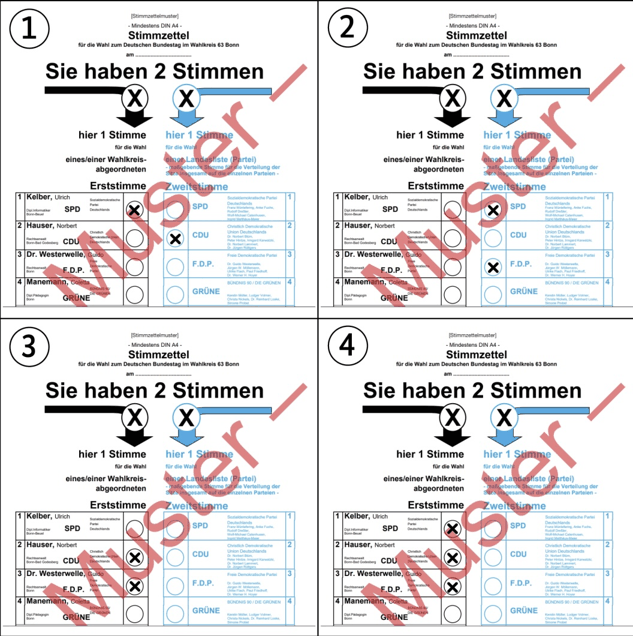
Welcher Stimmzettel wäre bei einer Bundestagswahl gültig?
Which ballot paper would be valid in a federal election?
In Anlehnung an Bundeswahlordnung (BWO), Anlage 26
11
22
33
44
Correct answer and explanation
A.1
1
A ballot paper is valid only if the marks are clearly made in accordance with the election rules. In the illustrated example, ballot paper 1 shows a valid vote.
Question 133
Was ist bei Bundestags- und Landtagswahlen in Deutschland erlaubt?
What is allowed in federal and state parliament elections in Germany?
Der Ehemann wählt für seine Frau mit.A husband votes on behalf of his wife as well.
Man kann durch Briefwahl seine Stimme abgeben.You can cast your vote by postal ballot.
Man kann am Wahltag telefonisch seine Stimme abgeben.You can cast your vote by telephone on election day.
Kinder ab dem Alter von 14 Jahren dürfen wählen.Children aged 14 and over are allowed to vote.
Correct answer and explanation
B.Man kann durch Briefwahl seine Stimme abgeben.
You can cast your vote by postal ballot.
Postal voting is allowed in federal and state parliament elections. This allows people to cast their vote even if they cannot go to the polling station on election day.
Question 216
Welches Symbol ist im Plenarsaal des Deutschen Bundestages zu sehen?
Which symbol can be seen in the plenary chamber of the German Bundestag?
der Bundesadlerthe Federal Eagle
die Fahne der Stadt Berlinthe flag of the city of Berlin
der Reichsadlerthe Imperial Eagle
die Reichskronethe Imperial Crown
Correct answer and explanation
A.der Bundesadler
the Federal Eagle
The Federal Eagle can be seen in the plenary chamber of the German Bundestag. It is an important state symbol of the Federal Republic of Germany.
These study pages use the same question dataset as the EBTest app, based on the BAMF catalogue dated 7 May 2025. Translations, study categories and explanations are independent learning aids, not official BAMF material. Check the BAMF for current information. Practice results are not official certificates.