Work through important periods of German history, including National Socialism, division and reunification. Put events in chronological order and connect dates with their significance instead of memorising isolated years.
English translations help you learn. The official examination is in German.
Vor wie vielen Jahren gab es erstmals eine jüdische Gemeinde auf dem Gebiet des heutigen Deutschlands?
How many years ago was there a Jewish community for the first time in the territory of present-day Germany?
vor etwa 300 Jahrenabout 300 years ago
vor etwa 700 Jahrenabout 700 years ago
vor etwa 1150 Jahrenabout 1,150 years ago
vor etwa 1700 Jahrenabout 1,700 years ago
Correct answer and explanation
D.vor etwa 1700 Jahren
about 1,700 years ago
Jewish life has existed in the territory of present-day Germany for about 1,700 years. An important early record comes from the Roman city of Cologne.
Question 151
Wer baute die Mauer in Berlin?
Who built the Wall in Berlin?
GroßbritannienGreat Britain
die DDRthe GDR
die Bundesrepublik Deutschlandthe Federal Republic of Germany
die USAthe USA
Correct answer and explanation
B.die DDR
the GDR
The Berlin Wall was built by the GDR. It was intended to prevent many people from fleeing from the GDR to West Berlin and the Federal Republic of Germany.
Question 152
Wann waren die Nationalsozialisten mit Adolf Hitler in Deutschland an der Macht?
When were the National Socialists under Adolf Hitler in power in Germany?
1918 bis 19231918 to 1923
1932 bis 19501932 to 1950
1933 bis 19451933 to 1945
1945 bis 19891945 to 1989
Correct answer and explanation
C.1933 bis 1945
1933 to 1945
The National Socialists under Adolf Hitler were in power from 1933 to 1945. During this period, Germany was a dictatorship.
Question 153
Was war am 8. Mai 1945?
What happened on May 8, 1945?
Tod Adolf HitlersDeath of Adolf Hitler
Beginn des Berliner MauerbausBeginning of the construction of the Berlin Wall
Wahl von Konrad Adenauer zum BundeskanzlerElection of Konrad Adenauer as Federal Chancellor
Ende des Zweiten Weltkriegs in EuropaEnd of the Second World War in Europe
Correct answer and explanation
D.Ende des Zweiten Weltkriegs in Europa
End of the Second World War in Europe
On May 8, 1945, the Second World War in Europe ended. Germany had surrendered militarily.
Question 154
Wann war der Zweite Weltkrieg zu Ende?
When did the Second World War end?
19331933
19451945
19491949
19611961
Correct answer and explanation
B.1945
1945
The Second World War ended in 1945. In Europe, the war was over in May 1945.
Question 155
Wann waren die Nationalsozialisten in Deutschland an der Macht?
When were the National Socialists in power in Germany?
1888 bis 19181888 to 1918
1921 bis 19341921 to 1934
1933 bis 19451933 to 1945
1949 bis 19631949 to 1963
Correct answer and explanation
C.1933 bis 1945
1933 to 1945
The National Socialists ruled Germany from 1933 to 1945. This period ended with Germany's defeat in the Second World War.
Question 156
In welchem Jahr wurde Hitler Reichskanzler?
In which year did Hitler become Reich Chancellor?
19231923
19271927
19331933
19361936
Correct answer and explanation
C.1933
1933
Adolf Hitler became Reich Chancellor in 1933. Shortly afterward, the National Socialists dismantled democracy and established a dictatorship.
Question 157
Die Nationalsozialisten mit Adolf Hitler errichteten 1933 in Deutschland …
In 1933, the National Socialists under Adolf Hitler established in Germany …
eine Diktatur.a dictatorship.
einen demokratischen Staat.a democratic state.
eine Monarchie.a monarchy.
ein Fürstentum.a principality.
Correct answer and explanation
A.eine Diktatur.
a dictatorship.
In 1933, the National Socialists established a dictatorship in Germany. Political opponents were persecuted and democratic rights were severely restricted.
Question 158
Das "Dritte Reich" war eine …
The "Third Reich" was a …
Diktatur.dictatorship.
Demokratie.democracy.
Monarchie.monarchy.
Räterepublik.council republic.
Correct answer and explanation
A.Diktatur.
dictatorship.
The so-called Third Reich was a dictatorship. There were no free elections or political freedom.
Question 159
Was gab es in Deutschland nicht während der Zeit des Nationalsozialismus?
What did not exist in Germany during the National Socialist era?
freie Wahlenfree elections
Pressezensurpress censorship
willkürliche Verhaftungenarbitrary arrests
Verfolgung von Judenpersecution of Jews
Correct answer and explanation
A.freie Wahlen
free elections
During the National Socialist era, there were no free elections. By contrast, there was censorship, arrests, and the systematic persecution of Jewish people.
Question 160
Welcher Krieg dauerte von 1939 bis 1945?
Which war lasted from 1939 to 1945?
der Erste Weltkriegthe First World War
der Zweite Weltkriegthe Second World War
der Vietnamkriegthe Vietnam War
der Golfkriegthe Gulf War
Correct answer and explanation
B.der Zweite Weltkrieg
the Second World War
The Second World War lasted from 1939 to 1945. In Europe, it began with Germany's attack on Poland.
Question 161
Was kennzeichnete den NS-Staat? Eine Politik …
What characterized the Nazi state? A policy of …
des staatlichen Rassismusstate-sponsored racism
der Meinungsfreiheitfreedom of expression
der allgemeinen Religionsfreiheitgeneral freedom of religion
der Entwicklung der Demokratiethe development of democracy
Correct answer and explanation
A.des staatlichen Rassismus
state-sponsored racism
The Nazi state was characterized by state-sponsored racism. People were persecuted and deprived of their rights because of their origin or alleged race.
Question 162
Claus Schenk Graf von Stauffenberg wurde bekannt durch …
Claus Schenk Graf von Stauffenberg became known for …
eine Goldmedaille bei den Olympischen Spielen 1936.winning a gold medal at the 1936 Olympic Games.
den Bau des Reichstagsgebäudes.the construction of the Reichstag building.
den Aufbau der Wehrmacht.the buildup of the Wehrmacht.
das Attentat auf Hitler am 20. Juli 1944.the assassination attempt on Hitler on July 20, 1944.
Correct answer and explanation
D.das Attentat auf Hitler am 20. Juli 1944.
the assassination attempt on Hitler on July 20, 1944.
Claus Schenk Graf von Stauffenberg became known for the assassination attempt on Hitler on July 20, 1944. The attempt to kill Hitler and overthrow the Nazi regime failed.
Question 163
In welchem Jahr zerstörten die Nationalsozialisten Synagogen und jüdische Geschäfte in Deutschland?
In which year did the National Socialists destroy synagogues and Jewish-owned businesses in Germany?
19251925
19301930
19381938
19451945
Correct answer and explanation
C.1938
1938
In 1938, National Socialists and their supporters destroyed many synagogues and Jewish-owned businesses. This violence was part of the increasing persecution of the Jewish population.
Question 164
Was passierte am 9. November 1938 in Deutschland?
What happened in Germany on November 9, 1938?
Mit dem Angriff auf Polen beginnt der Zweite Weltkrieg.The Second World War begins with the attack on Poland.
Die Nationalsozialisten verlieren eine Wahl und lösen den Reichstag auf.The National Socialists lose an election and dissolve the Reichstag.
Jüdische Geschäfte und Synagogen werden durch Nationalsozialisten und ihre Anhänger zerstört.Jewish-owned businesses and synagogues are destroyed by National Socialists and their supporters.
Hitler wird Reichspräsident und lässt alle Parteien verbieten.Hitler becomes Reich President and has all parties banned.
Correct answer and explanation
C.Jüdische Geschäfte und Synagogen werden durch Nationalsozialisten und ihre Anhänger zerstört.
Jewish-owned businesses and synagogues are destroyed by National Socialists and their supporters.
On November 9, 1938, synagogues and Jewish-owned businesses were destroyed in Germany. Many Jewish people were abused, arrested, or killed.
Question 165
Wie hieß der erste Bundeskanzler der Bundesrepublik Deutschland?
What was the name of the first Federal Chancellor of the Federal Republic of Germany?
Konrad AdenauerKonrad Adenauer
Kurt Georg KiesingerKurt Georg Kiesinger
Helmut SchmidtHelmut Schmidt
Willy BrandtWilly Brandt
Correct answer and explanation
A.Konrad Adenauer
Konrad Adenauer
Konrad Adenauer was the first Federal Chancellor of the Federal Republic of Germany. He governed from 1949 to 1963.
Question 166
Bei welchen Demonstrationen in Deutschland riefen die Menschen "Wir sind das Volk"?
At which demonstrations in Germany did people chant "We are the people"?
beim Arbeiteraufstand 1953 in der DDRduring the workers' uprising in the GDR in 1953
bei den Demonstrationen 1968 in der Bundesrepublik Deutschlandduring the 1968 demonstrations in the Federal Republic of Germany
bei den Anti-Atomkraft-Demonstrationen 1985 in der Bundesrepublik Deutschlandduring the anti-nuclear demonstrations in the Federal Republic of Germany in 1985
bei den Montagsdemonstrationen 1989 in der DDRduring the Monday demonstrations in the GDR in 1989
Correct answer and explanation
D.bei den Montagsdemonstrationen 1989 in der DDR
during the Monday demonstrations in the GDR in 1989
The slogan "We are the people" became particularly well known during the Monday demonstrations in the GDR in 1989. People demanded political change and greater freedom.
Question 167
Welche Länder wurden nach dem Zweiten Weltkrieg in Deutschland als "Alliierte Besatzungsmächte" bezeichnet?
Which countries were referred to as the "Allied occupying powers" in Germany after the Second World War?
Sowjetunion, Großbritannien, Polen, SchwedenSoviet Union, Great Britain, Poland, Sweden
Frankreich, Sowjetunion, Italien, JapanFrance, Soviet Union, Italy, Japan
USA, Sowjetunion, Spanien, PortugalUSA, Soviet Union, Spain, Portugal
USA, Sowjetunion, Großbritannien, FrankreichUSA, Soviet Union, Great Britain, France
Correct answer and explanation
D.USA, Sowjetunion, Großbritannien, Frankreich
USA, Soviet Union, Great Britain, France
After the Second World War, the USA, the Soviet Union, Great Britain, and France were occupying powers in Germany. They divided Germany into four occupation zones.
Question 168
Welches Land war keine "Alliierte Besatzungsmacht" in Deutschland?
Which country was not an "Allied occupying power" in Germany?
USAUSA
SowjetunionSoviet Union
FrankreichFrance
JapanJapan
Correct answer and explanation
D.Japan
Japan
Japan was not an occupying power in Germany. The four occupying powers were the USA, the Soviet Union, Great Britain, and France.
Question 169
Wann wurde die Bundesrepublik Deutschland gegründet?
When was the Federal Republic of Germany founded?
19391939
19451945
19491949
19511951
Correct answer and explanation
C.1949
1949
The Federal Republic of Germany was founded in 1949. It emerged from the western occupation zones.
Question 170
Was gab es während der Zeit des Nationalsozialismus in Deutschland?
What existed in Germany during the National Socialist era?
das Verbot von Parteienthe banning of political parties
das Recht zur freien Entfaltung der Persönlichkeitthe right to free development of one's personality
Pressefreiheitfreedom of the press
den Schutz der Menschenwürdethe protection of human dignity
Correct answer and explanation
A.das Verbot von Parteien
the banning of political parties
Under National Socialism, other political parties were banned. The Nazi Party was intended to be the only political power in the state.
Question 172
In welcher Besatzungszone wurde die DDR gegründet? In der …
In which occupation zone was the GDR founded? In the …
amerikanischen BesatzungszoneAmerican occupation zone
französischen BesatzungszoneFrench occupation zone
britischen BesatzungszoneBritish occupation zone
sowjetischen BesatzungszoneSoviet occupation zone
Correct answer and explanation
D.sowjetischen Besatzungszone
Soviet occupation zone
The GDR was founded in the Soviet occupation zone. It was established in eastern Germany in 1949.
Question 174
Wann wurde die DDR gegründet?
When was the GDR founded?
19471947
19491949
19531953
19561956
Correct answer and explanation
B.1949
1949
The GDR was founded in 1949. It was established in the territory of the Soviet occupation zone.
Question 175
Wie viele Besatzungszonen gab es in Deutschland nach dem Zweiten Weltkrieg?
How many occupation zones were there in Germany after the Second World War?
33
44
55
66
Correct answer and explanation
B.4
4
After the Second World War, Germany was divided into four occupation zones. They were administered by the USA, the Soviet Union, Great Britain, and France.
Question 176
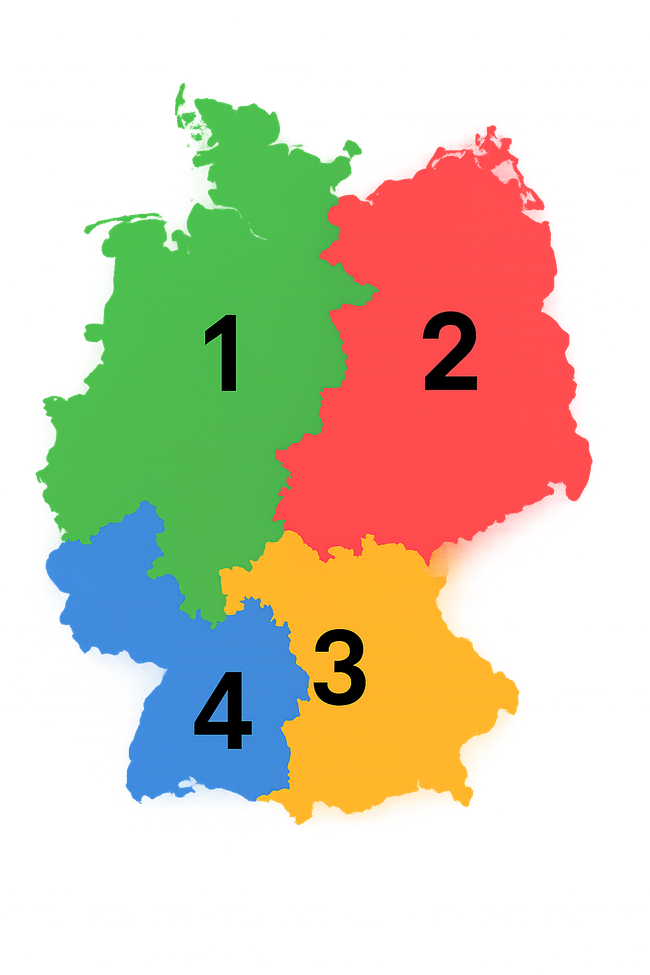
Wie waren die Besatzungszonen Deutschlands nach 1945 verteilt?
How were Germany's occupation zones distributed after 1945?
After 1945, Germany was divided into four occupation zones. The correct assignment on the map is Great Britain, Soviet Union, USA, and France according to the marked areas.
Question 177
Welche deutsche Stadt wurde nach dem Zweiten Weltkrieg in vier Sektoren aufgeteilt?
Which German city was divided into four sectors after the Second World War?
MünchenMunich
BerlinBerlin
DresdenDresden
Frankfurt / OderFrankfurt (Oder)
Correct answer and explanation
B.Berlin
Berlin
Berlin was divided into four sectors after the Second World War. Although the city lay within the Soviet occupation zone, the three Western Allies also controlled parts of Berlin.
Question 178
Vom Juni 1948 bis zum Mai 1949 wurden die Bürgerinnen und Bürger von West-Berlin durch eine Luftbrücke versorgt. Welcher Umstand war dafür verantwortlich?
From June 1948 to May 1949, the citizens of West Berlin were supplied by an airlift. What circumstance made this necessary?
Für Frankreich war eine Versorgung der West-Berliner Bevölkerung mit dem Flugzeug kostengünstiger.For France, supplying the population of West Berlin by airplane was less expensive.
Die amerikanischen Soldatinnen und Soldaten hatten beim Landtransport Angst vor Überfällen.The American soldiers were afraid of attacks during overland transport.
Für Großbritannien war die Versorgung über die Luftbrücke schneller.For Great Britain, supplying West Berlin via the airlift was faster.
Die Sowjetunion unterbrach den gesamten Verkehr auf dem Landwege.The Soviet Union cut off all overland traffic.
Correct answer and explanation
D.Die Sowjetunion unterbrach den gesamten Verkehr auf dem Landwege.
The Soviet Union cut off all overland traffic.
During the Berlin Blockade of 1948 and 1949, the Soviet Union blocked the land and water routes to West Berlin. Therefore, the Western Allies supplied the city by aircraft through the airlift.
Question 179
Wie endete der Zweite Weltkrieg in Europa offiziell?
How did the Second World War in Europe officially end?
mit dem Tod Adolf Hitlerswith the death of Adolf Hitler
durch die bedingungslose Kapitulation Deutschlandswith Germany's unconditional surrender
mit dem Rückzug der Deutschen aus den besetzten Gebietenwith the withdrawal of German forces from the occupied territories
durch eine Revolution in Deutschlandthrough a revolution in Germany
Correct answer and explanation
B.durch die bedingungslose Kapitulation Deutschlands
with Germany's unconditional surrender
The Second World War in Europe officially ended with Germany's unconditional surrender. This meant that the German Wehrmacht ceased fighting.
Question 180
Der erste Bundeskanzler der Bundesrepublik Deutschland war …
The first Federal Chancellor of the Federal Republic of Germany was …
Ludwig Erhard.Ludwig Erhard.
Willy Brandt.Willy Brandt.
Konrad Adenauer.Konrad Adenauer.
Gerhard Schröder.Gerhard Schröder.
Correct answer and explanation
C.Konrad Adenauer.
Konrad Adenauer.
The first Federal Chancellor of the Federal Republic of Germany was Konrad Adenauer. He took office in 1949.
Question 181
Was wollte Willy Brandt mit seinem Kniefall 1970 im ehemaligen jüdischen Ghetto in Warschau ausdrücken?
What did Willy Brandt intend to express with his kneeling gesture in 1970 at the former Jewish ghetto in Warsaw?
Er hat sich den ehemaligen Alliierten unterworfen.He submitted to the former Allies.
Er bat Polen und die polnischen Juden um Vergebung.He asked Poland and Polish Jews for forgiveness.
Er zeigte seine Demut vor dem Warschauer Pakt.He showed his humility before the Warsaw Pact.
Er sprach ein Gebet am Grab des Unbekannten Soldaten.He said a prayer at the Tomb of the Unknown Soldier.
Correct answer and explanation
B.Er bat Polen und die polnischen Juden um Vergebung.
He asked Poland and Polish Jews for forgiveness.
Willy Brandt's kneeling gesture in Warsaw in 1970 was a sign of humility and remembrance for the victims of National Socialism. It was understood as a plea for forgiveness and an important symbol of reconciliation.
Question 183
Wann war in der Bundesrepublik Deutschland das "Wirtschaftswunder"?
When did the "economic miracle" take place in the Federal Republic of Germany?
40er Jahre1940s
50er Jahre1950s
70er Jahre1970s
80er Jahre1980s
Correct answer and explanation
B.50er Jahre
1950s
The German economic miracle is associated mainly with the 1950s. During this period, the economy of the Federal Republic grew very rapidly.
Question 184
Auf welcher rechtlichen Grundlage wurde der Staat Israel gegründet?
On what legal basis was the State of Israel founded?
eine Resolution der Vereinten Nationena resolution of the United Nations
ein Beschluss des Zionistenkongressesa decision of the Zionist Congress
ein Vorschlag der Bundesregierunga proposal by the Federal Government
ein Vorschlag der UdSSRa proposal by the USSR
Correct answer and explanation
A.eine Resolution der Vereinten Nationen
a resolution of the United Nations
The founding of the State of Israel was connected to a 1947 United Nations resolution that provided for a partition plan for the then British Mandate territory of Palestine.
Question 185
Wofür stand der Ausdruck "Eiserner Vorhang"? Für die Abschottung …
What did the term "Iron Curtain" refer to? The isolation of …
des Warschauer Pakts gegen den Westenthe Warsaw Pact from the West
Norddeutschlands gegen Süddeutschlandnorthern Germany from southern Germany
Nazi-Deutschlands gegen die AlliiertenNazi Germany from the Allies
Europas gegen die USAEurope from the USA
Correct answer and explanation
A.des Warschauer Pakts gegen den Westen
the Warsaw Pact from the West
The term "Iron Curtain" referred to the political and military division between the communist East of Europe and the West during the Cold War.
Question 186
Im Jahr 1953 gab es in der DDR einen Aufstand, an den lange Zeit in der Bundesrepublik Deutschland ein Feiertag erinnerte. Wann war das?
In 1953, there was an uprising in the GDR that was commemorated for many years by a public holiday in the Federal Republic of Germany. When was it?
1. MaiMay 1
17. JuniJune 17
20. JuliJuly 20
9. NovemberNovember 9
Correct answer and explanation
B.17. Juni
June 17
On June 17, 1953, a major uprising against the government took place in the GDR. For many years, a public holiday in the Federal Republic commemorated this date.
Question 187
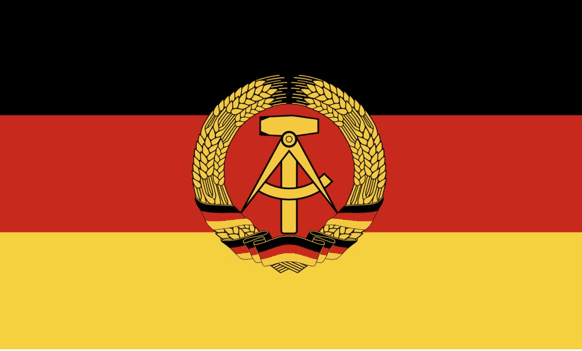
Welcher deutsche Staat hatte eine schwarz-rot-goldene Flagge mit Hammer, Zirkel und Ährenkranz?
Which German state had a black-red-gold flag with a hammer, compass, and wreath of grain?
PreußenPrussia
Bundesrepublik DeutschlandFederal Republic of Germany
"Drittes Reich""Third Reich"
DDRGDR
Correct answer and explanation
D.DDR
GDR
The GDR had a black-red-gold flag with a hammer, compass, and wreath of grain. These symbols represented workers, intellectuals, and farmers.
Question 188
In welchem Jahr wurde die Mauer in Berlin gebaut?
In which year was the Wall in Berlin built?
19531953
19561956
19591959
19611961
Correct answer and explanation
D.1961
1961
The Berlin Wall was built in 1961. On August 13, 1961, the GDR began sealing off the border with West Berlin.
Question 189
Wann baute die DDR die Mauer in Berlin?
When did the GDR build the Wall in Berlin?
19191919
19331933
19611961
19901990
Correct answer and explanation
C.1961
1961
The GDR built the Berlin Wall in 1961. It was intended to stop many people from fleeing from the GDR to the West.
Question 190
Was bedeutet die Abkürzung DDR?
What does the abbreviation GDR stand for?
Dritter Deutscher RundfunkThird German Broadcasting Service
Die Deutsche RepublikThe German Republic
Dritte Deutsche RepublikThird German Republic
Deutsche Demokratische RepublikGerman Democratic Republic
Correct answer and explanation
D.Deutsche Demokratische Republik
German Democratic Republic
GDR stands for German Democratic Republic. It existed from 1949 to 1990.
Question 191
Wann wurde die Mauer in Berlin für alle geöffnet?
When was the Wall in Berlin opened to everyone?
19871987
19891989
19921992
19951995
Correct answer and explanation
B.1989
1989
The Berlin Wall was opened on November 9, 1989. After that, people from the GDR could freely cross the border into West Berlin.
Question 192
Welches heutige deutsche Bundesland gehörte früher zum Gebiet der DDR?
Which present-day German federal state formerly belonged to the territory of the GDR?
BrandenburgBrandenburg
BayernBavaria
SaarlandSaarland
HessenHesse
Correct answer and explanation
A.Brandenburg
Brandenburg
Brandenburg belonged to the territory of the GDR. After German reunification in 1990, it once again became a federal state.
Question 193
Von 1961 bis 1989 war Berlin …
From 1961 to 1989, Berlin was …
ohne Bürgermeister.without a mayor.
ein eigener Staat.an independent state.
durch eine Mauer geteilt.divided by a wall.
nur mit dem Flugzeug erreichbar.reachable only by airplane.
Correct answer and explanation
C.durch eine Mauer geteilt.
divided by a wall.
From 1961 to 1989, Berlin was divided by the Wall. West Berlin and East Berlin belonged to different political systems.
Question 194
Am 3. Oktober feiert man in Deutschland den Tag der Deutschen …
On October 3, Germany celebrates the Day of German …
Einheit.Unity.
Nation.Nation.
Bundesländer.Federal States.
Städte.Cities.
Correct answer and explanation
A.Einheit.
Unity.
On October 3, Germany celebrates the Day of German Unity. It commemorates the reunification of the Federal Republic of Germany and the GDR in 1990.
Question 195
Welches heutige deutsche Bundesland gehörte früher zum Gebiet der DDR?
Which present-day German federal state formerly belonged to the territory of the GDR?
HessenHesse
Sachsen-AnhaltSaxony-Anhalt
Nordrhein-WestfalenNorth Rhine-Westphalia
SaarlandSaarland
Correct answer and explanation
B.Sachsen-Anhalt
Saxony-Anhalt
Saxony-Anhalt was formerly part of the territory of the GDR. Since 1990, it has been one of Germany's 16 federal states.
Question 196
Warum nennt man die Zeit im Herbst 1989 in der DDR "Die Wende"? In dieser Zeit veränderte sich die DDR politisch …
Why is the period in the autumn of 1989 in the GDR called "Die Wende" (the turning point)? During this period, the GDR changed politically …
von einer Diktatur zur Demokratie.from a dictatorship to a democracy.
von einer liberalen Marktwirtschaft zum Sozialismus.from a liberal market economy to socialism.
von einer Monarchie zur Sozialdemokratie.from a monarchy to social democracy.
von einem religiösen Staat zu einem kommunistischen Staat.from a religious state to a communist state.
Correct answer and explanation
A.von einer Diktatur zur Demokratie.
from a dictatorship to a democracy.
The term "Die Wende" refers to the political changes in the GDR in the autumn of 1989. The dictatorship lost its power, and the path toward free elections and democracy began.
Question 197
Welches heutige deutsche Bundesland gehörte früher zum Gebiet der DDR?
Which present-day German federal state formerly belonged to the territory of the GDR?
ThüringenThuringia
HessenHesse
BayernBavaria
BremenBremen
Correct answer and explanation
A.Thüringen
Thuringia
Thuringia belonged to the territory of the GDR. After reunification, Thuringia once again became a federal state.
Question 198
Welches heutige deutsche Bundesland gehörte früher zum Gebiet der DDR?
Which present-day German federal state formerly belonged to the territory of the GDR?
BayernBavaria
NiedersachsenLower Saxony
SachsenSaxony
Baden-WürttembergBaden-Württemberg
Correct answer and explanation
C.Sachsen
Saxony
Saxony formerly belonged to the GDR. Since German reunification in 1990, Saxony has once again been a federal state.
Question 199
Mit der Abkürzung "Stasi" meinte man in der DDR …
In the GDR, the abbreviation "Stasi" referred to …
das Parlament.the parliament.
das Ministerium für Staatssicherheit.the Ministry for State Security.
eine regierende Partei.a governing political party.
das Ministerium für Volksbildung.the Ministry of National Education.
Correct answer and explanation
B.das Ministerium für Staatssicherheit.
the Ministry for State Security.
"Stasi" was the short form for the GDR's Ministry for State Security. It monitored many people and acted against political opponents.
Question 200
Welches heutige deutsche Bundesland gehörte früher zum Gebiet der DDR?
Which present-day German federal state formerly belonged to the territory of the GDR?
Mecklenburg-Western Pomerania belonged to the territory of the GDR. Since 1990, it has once again been a federal state of the Federal Republic of Germany.
Question 201
Welche der folgenden Auflistungen enthält nur Bundesländer, die zum Gebiet der früheren DDR gehörten?
Which of the following lists contains only federal states that belonged to the territory of the former GDR?
The present-day federal states of Mecklenburg-Western Pomerania, Brandenburg, Saxony, Saxony-Anhalt, and Thuringia belonged to the former GDR. These five states are often referred to as the new federal states.
Question 202
Zu wem gehörte die DDR im "Kalten Krieg"?
Which side did the GDR belong to during the "Cold War"?
zu den Westmächtenthe Western powers
zum Warschauer Paktthe Warsaw Pact
zur NATONATO
zu den blockfreien Staatenthe non-aligned states
Correct answer and explanation
B.zum Warschauer Pakt
the Warsaw Pact
During the Cold War, the GDR belonged to the Eastern Bloc and was a member of the Warsaw Pact. This military alliance was led by the Soviet Union.
Question 203
Wie hieß das Wirtschaftssystem der DDR?
What was the economic system of the GDR called?
Marktwirtschaftmarket economy
Planwirtschaftplanned economy
Angebot und Nachfragesupply and demand
Kapitalismuscapitalism
Correct answer and explanation
B.Planwirtschaft
planned economy
The GDR had a planned economy. The state planned what and how much was produced and set many prices.
Question 204
Wie wurden die Bundesrepublik Deutschland und die DDR zu einem Staat?
How did the Federal Republic of Germany and the GDR become one state?
Die Bundesrepublik hat die DDR besetzt.The Federal Republic occupied the GDR.
Die heutigen fünf östlichen Bundesländer sind der Bundesrepublik Deutschland beigetreten.The five present-day eastern federal states joined the Federal Republic of Germany.
Die westlichen Bundesländer sind der DDR beigetreten.The western federal states joined the GDR.
Die DDR hat die Bundesrepublik Deutschland besetzt.The GDR occupied the Federal Republic of Germany.
Correct answer and explanation
B.Die heutigen fünf östlichen Bundesländer sind der Bundesrepublik Deutschland beigetreten.
The five present-day eastern federal states joined the Federal Republic of Germany.
In 1990, the GDR joined the Federal Republic of Germany. The five present-day eastern federal states thereby became part of the Federal Republic.
Question 205
Mit dem Beitritt der DDR zur Bundesrepublik Deutschland gehören die neuen Bundesländer nun auch …
With the accession of the GDR to the Federal Republic of Germany, the new federal states now also belong …
zur Europäischen Union.to the European Union.
zum Warschauer Pakt.to the Warsaw Pact.
zur OPEC.to OPEC.
zur Europäischen Verteidigungsgemeinschaft.to the European Defence Community.
Correct answer and explanation
A.zur Europäischen Union.
to the European Union.
With German reunification, the new federal states automatically became part of the European Community and later of the European Union.
Question 206
Woran erinnern die sogenannten "Stolpersteine" in Deutschland?
What do the so-called "Stumbling Stones" in Germany commemorate?
an berühmte deutsche Politikerinnen und Politikerfamous German politicians
an die Opfer des Nationalsozialismusthe victims of National Socialism
an Verkehrstoteroad traffic fatalities
an bekannte jüdische Musikerwell-known Jewish musicians
Correct answer and explanation
B.an die Opfer des Nationalsozialismus
the victims of National Socialism
Stumbling Stones commemorate people who were persecuted and murdered by the National Socialist regime. They are usually placed in front of the victims' former homes.
Question 207
In welchem Militärbündnis war die DDR Mitglied?
Which military alliance was the GDR a member of?
in der NATONATO
im Rheinbundthe Confederation of the Rhine
im Warschauer Paktthe Warsaw Pact
im Europabündnisthe European Alliance
Correct answer and explanation
C.im Warschauer Pakt
the Warsaw Pact
The GDR was a member of the Warsaw Pact. It was the military alliance of the socialist states in Eastern Europe.
Question 208
Was war die "Stasi"?
What was the "Stasi"?
der Geheimdienst im "Dritten Reich"the secret service in the "Third Reich"
eine berühmte deutsche Gedenkstättea famous German memorial site
der Geheimdienst der DDRthe secret service of the GDR
ein deutscher Sportverein während des Zweiten Weltkriegesa German sports club during the Second World War
Correct answer and explanation
C.der Geheimdienst der DDR
the secret service of the GDR
The Stasi was the State Security Service of the GDR. It monitored many people and collected information about actual or suspected opponents of the state.
Question 209
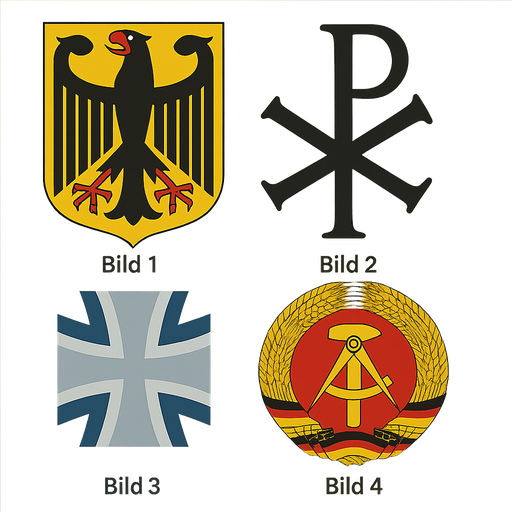
Welches war das Wappen der Deutschen Demokratischen Republik?
Which was the coat of arms of the German Democratic Republic?
Bild 1Image 1
Bild 2Image 2
Bild 3Image 3
Bild 4Image 4
Correct answer and explanation
D.Bild 4
Image 4
The coat of arms of the GDR showed a hammer and compass surrounded by a wreath of grain. It represented workers, intellectuals, and farmers.
Question 210
Was ereignete sich am 17. Juni 1953 in der DDR?
What happened on June 17, 1953, in the GDR?
der feierliche Beitritt zum Warschauer Paktthe ceremonial accession to the Warsaw Pact
landesweite Streiks und ein Volksaufstandnationwide strikes and a popular uprising
der 1. SED-Parteitagthe first SED party congress
der erste Besuch Fidel CastrosFidel Castro's first visit
Correct answer and explanation
B.landesweite Streiks und ein Volksaufstand
nationwide strikes and a popular uprising
On June 17, 1953, major strikes and a popular uprising took place in the GDR. Soviet troops violently suppressed the uprising.
Question 211
Welcher Politiker steht für die "Ostverträge"?
Which politician is associated with the "Eastern Treaties"?
Helmut KohlHelmut Kohl
Willy BrandtWilly Brandt
Michail GorbatschowMikhail Gorbachev
Ludwig ErhardLudwig Erhard
Correct answer and explanation
B.Willy Brandt
Willy Brandt
Willy Brandt is particularly associated with the Eastern Treaties. His government wanted to improve relations with the countries of Eastern Europe and reduce political tensions.
Question 215
Wer wird als "Kanzler der Deutschen Einheit" bezeichnet?
Who is referred to as the "Chancellor of German Unity"?
Gerhard SchröderGerhard Schröder
Helmut KohlHelmut Kohl
Konrad AdenauerKonrad Adenauer
Helmut SchmidtHelmut Schmidt
Correct answer and explanation
B.Helmut Kohl
Helmut Kohl
Helmut Kohl is often referred to as the Chancellor of German Unity. Germany was reunified in 1990 during his term in office.
Question 217
In welchem Zeitraum gab es die Deutsche Demokratische Republik (DDR)?
During which period did the German Democratic Republic (GDR) exist?
1919 bis 19271919 to 1927
1933 bis 19451933 to 1945
1945 bis 19611945 to 1961
1949 bis 19901949 to 1990
Correct answer and explanation
D.1949 bis 1990
1949 to 1990
The GDR existed from 1949 to 1990. It ceased to exist with German reunification on October 3, 1990.
Question 218
Wie viele Bundesländer kamen bei der Wiedervereinigung 1990 zur Bundesrepublik Deutschland hinzu?
How many federal states were added to the Federal Republic of Germany during reunification in 1990?
44
55
66
77
Correct answer and explanation
B.5
5
During reunification, five federal states were added to the Federal Republic: Brandenburg, Mecklenburg-Western Pomerania, Saxony, Saxony-Anhalt, and Thuringia.
Question 219
Die Bundesrepublik Deutschland hat die Grenzen von heute seit …
The Federal Republic of Germany has had its present borders since …
19331933
19491949
19711971
19901990
Correct answer and explanation
D.1990
1990
Germany has had its present borders since reunification in 1990. At that time, the GDR and the Federal Republic became one state.
Question 220
Der 27. Januar ist in Deutschland ein offizieller Gedenktag. Woran erinnert dieser Tag?
January 27 is an official day of remembrance in Germany. What does this day commemorate?
an das Ende des Zweiten Weltkriegesthe end of the Second World War
an die Verabschiedung des Grundgesetzesthe adoption of the Basic Law
an die Wiedervereinigung Deutschlandsthe reunification of Germany
an die Opfer des Nationalsozialismus (Tag der Befreiung des Vernichtungslagers Auschwitz)the victims of National Socialism (day of the liberation of the Auschwitz extermination camp)
Correct answer and explanation
D.an die Opfer des Nationalsozialismus (Tag der Befreiung des Vernichtungslagers Auschwitz)
the victims of National Socialism (day of the liberation of the Auschwitz extermination camp)
January 27 commemorates the victims of National Socialism. On this day in 1945, the Auschwitz concentration and extermination camp was liberated.
Question 228
Wie wird der Beitritt der DDR zur Bundesrepublik Deutschland im Jahr 1990 allgemein genannt?
What is the GDR's accession to the Federal Republic of Germany in 1990 commonly called?
NATO-OsterweiterungNATO's eastward expansion
EU-OsterweiterungEU eastward enlargement
Deutsche WiedervereinigungGerman reunification
Europäische GemeinschaftEuropean Community
Correct answer and explanation
C.Deutsche Wiedervereinigung
German reunification
The GDR's accession to the Federal Republic of Germany in 1990 is commonly called German reunification. Since then, there has once again been a single German state.
Question 235
Der damalige französische Staatspräsident François Mitterrand und der damalige deutsche Bundeskanzler Helmut Kohl gedenken in Verdun gemeinsam der Toten beider Weltkriege. Welches Ziel der Europäischen Union wird bei diesem Treffen deutlich?
The then French President François Mitterrand and the then German Chancellor Helmut Kohl jointly commemorate the dead of both world wars in Verdun. Which goal of the European Union is illustrated by this meeting?
Freundschaft zwischen England und Deutschlandfriendship between England and Germany
Reisefreiheit in alle Länder der EUfreedom to travel in all EU countries
Frieden und Sicherheit in den Ländern der EUpeace and security in the countries of the EU
einheitliche Feiertage in den Ländern der EUuniform public holidays in the countries of the EU
Correct answer and explanation
C.Frieden und Sicherheit in den Ländern der EU
peace and security in the countries of the EU
The joint commemoration by François Mitterrand and Helmut Kohl in Verdun stands for reconciliation. It illustrates the goal of securing lasting peace and security in Europe.
Question 288
Woraus begründet sich Deutschlands besondere Verantwortung für Israel?
What is Germany's special responsibility for Israel based on?
aus der Mitgliedschaft in der Europäischen Union (EU)membership in the European Union (EU)
aus den nationalsozialistischen Verbrechen gegen Judenthe National Socialist crimes against Jews
aus dem Grundgesetz der Bundesrepublik Deutschlandthe Basic Law of the Federal Republic of Germany
aus der christlichen Traditionthe Christian tradition
Correct answer and explanation
B.aus den nationalsozialistischen Verbrechen gegen Juden
the National Socialist crimes against Jews
Germany's special responsibility for Israel is connected to the National Socialist crimes against European Jews. This includes, in particular, remembrance of the Holocaust.
Question 298
In der DDR lebten vor allem Migrantinnen und Migranten aus …
These study pages use the same question dataset as the EBTest app, based on the BAMF catalogue dated 7 May 2025. Translations, study categories and explanations are independent learning aids, not official BAMF material. Check the BAMF for current information. Practice results are not official certificates.